
For parents, students and self-learners planning an ABRSM exam: what each exam tests, how it is marked and how to book.
ABRSM exams are graded music exams run by the Associated Board of the Royal Schools of Music, from Initial Grade to Grade 8. Practical and Performance Grades are marked out of 150: 100 is a Pass and 130 a Distinction, and Grades 6–8 require a Grade 5 Music Theory pass or equivalent first.
What are the ABRSM exam levels and types?
ABRSM exams run from Initial Grade to Grade 8 in three main types: face-to-face Practical Grades, video-recorded Performance Grades and Music Theory.
| Exam | Format | What is assessed | When to book |
|---|---|---|---|
| Practical Grades | Face to face with an examiner | 3 pieces, scales and arpeggios, sight-reading, aural tests | Only in published booking periods |
| Performance Grades | Video you record and upload | 4 pieces (3 from the syllabus + 1 own choice) in one continuous take | Any time; upload within 28 days |
| Music Theory Grades 1–5 | Online exam | Written theory | Any time; complete within 28 days |
| Music Theory Grades 6–8 | Paper-based exam | Written theory | Only in published booking periods |
ABRSM says Performance Grades are equal in demand and value to Practical Grades; they assess performance only, with no scales, sight-reading or aural tests.
What is the ABRSM mark scheme and pass mark?
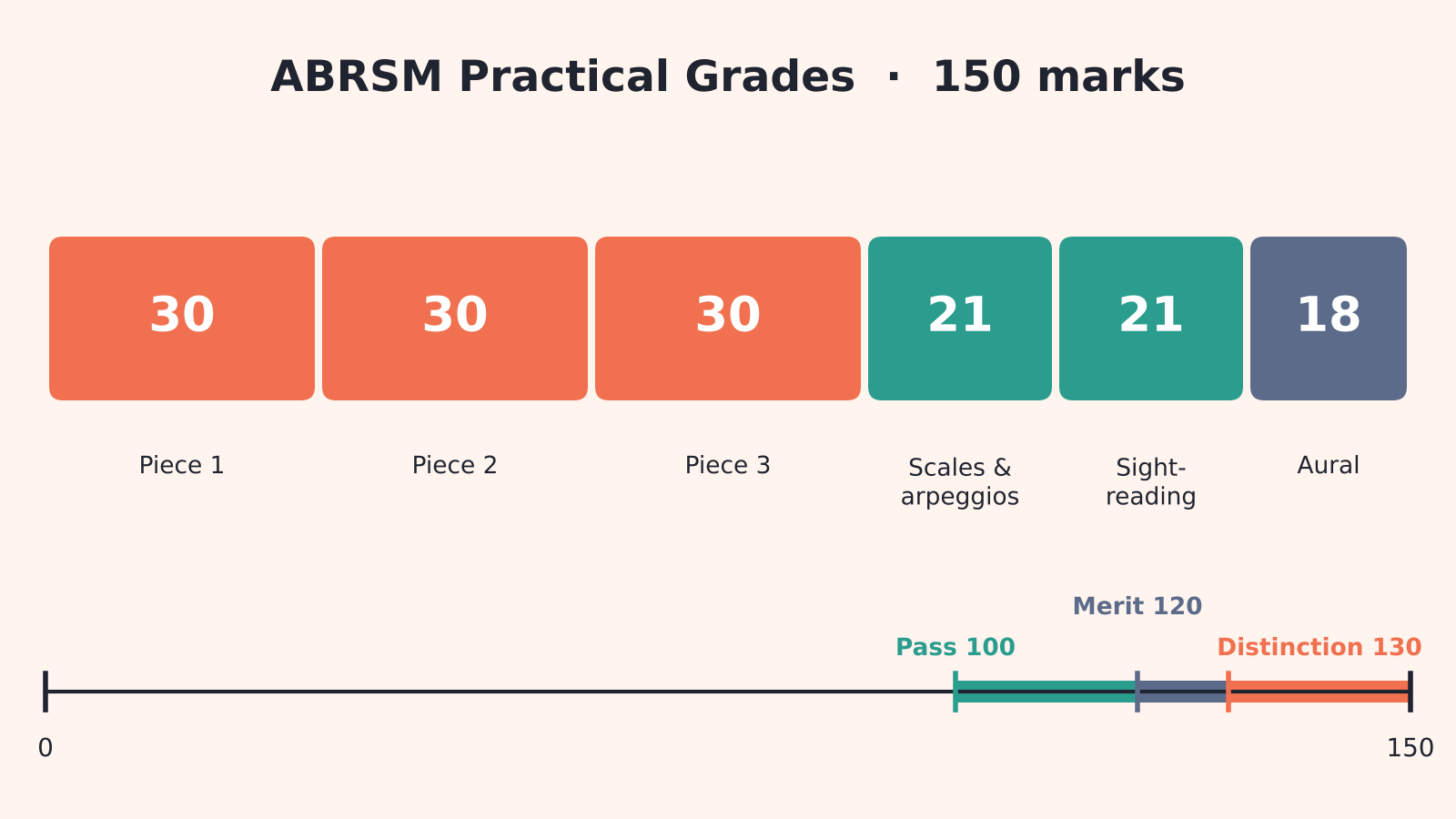
ABRSM Practical Grades are marked out of 150: each of the 3 pieces is worth 30 marks, and the remaining 60 come from scales, sight-reading and aural tests.
| Component | Maximum marks |
|---|---|
| Piece 1 | 30 |
| Piece 2 | 30 |
| Piece 3 | 30 |
| Scales and arpeggios | 21 |
| Sight-reading | 21 |
| Aural tests | 18 |
| Total | 150 |
| Result | Marks |
|---|---|
| Distinction | 130–150 |
| Merit | 120–129 |
| Pass | 100–119 |
Candidates do not need to pass every section to pass overall. For sight-reading practice, see our sight-reading tips.
Do you need ABRSM Grade 5 Theory for Grade 6?
Yes. Before booking a Practical Grade 6, 7 or 8, candidates must have passed ABRSM Grade 5 (or above) in one of these:
- Music Theory
- Practical Musicianship
- a Jazz Practical Grade
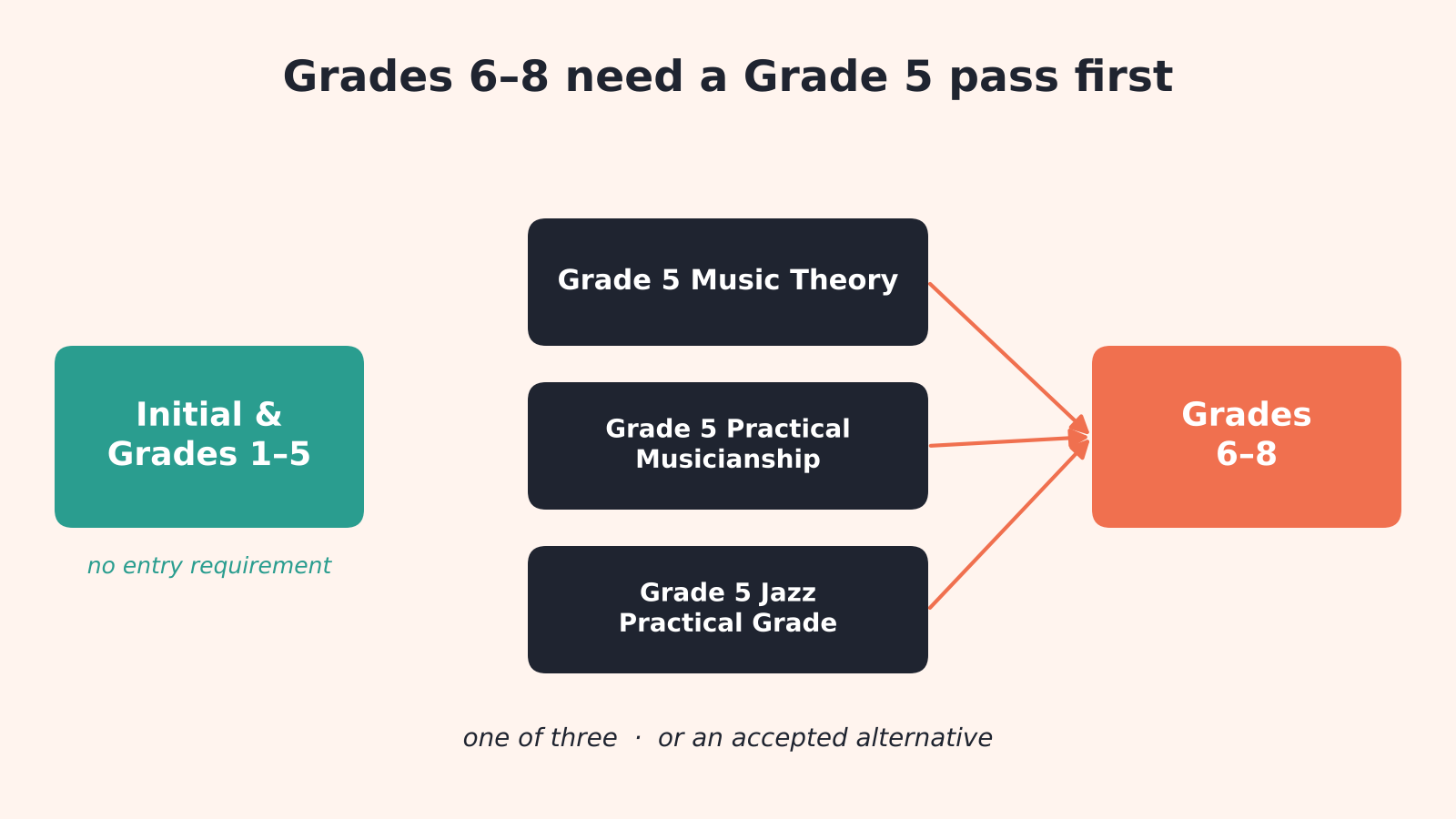
ABRSM also lists accepted alternatives on its website. Initial Grade and Grades 1–5 have no entry requirements, and candidates of any age can enter. New to reading notation? Start with our staff notation basics.
ABRSM piano syllabus 2027 vs violin: what is different?
ABRSM piano and violin Practical Grades share the same structure (3 pieces, scales and arpeggios, sight-reading, aural tests, 150 marks); the main differences are the syllabus and accompaniment.
| Piano | Violin | |
|---|---|---|
| Current syllabus | 2027 & 2028, valid from 1 January 2027 | “from 2024”, valid from 1 January 2024 until further notice |
| Old pieces | 2025 & 2026 pieces allowed until 31 December 2027; all pieces in one exam must come from the same syllabus | Overlap ended |
| Scales, sight-reading, aural | Unchanged in the new syllabus | Unchanged in the 2024 revision |
| Accompaniment | Solo | Some pieces have piano accompaniment, usually arranged by the candidate |
Just starting out on violin? See our violin guide for beginners.
What is in the ABRSM Grade 8 piano exam?
ABRSM Grade 8 is the highest graded exam and follows the same structure as other grades: 3 pieces, scales and arpeggios, sight-reading and aural tests, out of 150. A Grade 5 Theory pass or equivalent is required first. After Grade 8, candidates can go on to ABRSM diplomas such as ARSM. Not sure where to start? Read which piano grade to start with.
How do you book an ABRSM exam?
Practical Grade exam periods, booking windows and fees are set by country, so check the ABRSM page for your country before booking. Performance Grades and Music Theory Grades 1–5 have no booking periods.
- Agree the exam type (Practical or Performance) and grade with your teacher.
- For Grades 6–8, check you have passed Grade 5 Theory or an accepted alternative.
- Book online through ABRSM: choose a venue and date for Practical Grades, or upload your video within 28 days for Performance Grades.
How should you prepare for an ABRSM exam?
One common approach is to start about three months before the exam: practise pieces slowly in sections and spend a little time on scales, sight-reading and aural every day. See our piano exam prep guide for a timeline, and use a metronome for slow practice.
At home, you can scan your exam pieces with MusPal, listen with adjustable-tempo playback, then play while AI points out pitch, rhythm and dynamics issues bar by bar, so you know which bars need more work.
FAQ
What is the pass mark for ABRSM exams?
Practical and Performance Grades are out of 150: 100 is a Pass, 120 a Merit and 130 a Distinction.
Are Performance Grades worth the same as Practical Grades?
ABRSM says they are equal in demand and value; Performance Grades assess 4 recorded pieces, Practical Grades 3 pieces plus scales, sight-reading and aural.
Can you skip ABRSM grades?
Yes. ABRSM does not require lower grades first, but Grades 6–8 need a Grade 5 Theory pass or equivalent.
Which syllabus is used for ABRSM violin exams?
The “from 2024” Bowed Strings syllabus, valid from 1 January 2024 until further notice.
Sources
- ABRSM: Practical Grades
- ABRSM: About Performance Grades
- ABRSM: Piano Practical Grades Syllabus 2027 & 2028
- ABRSM: Violin
- ABRSM: Exam regulations
Update log
- 2026-11-23: First version.
Free plan: 3 scans + 3 AI analyses every month