
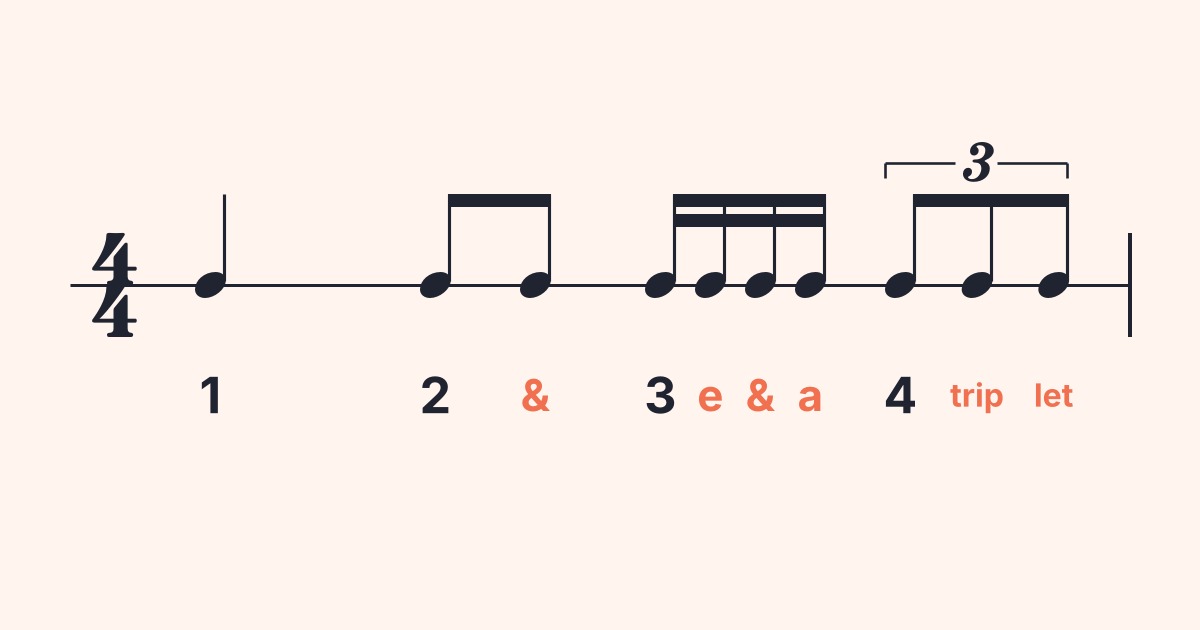
To count rhythms, give every beat a number and every subdivision a syllable. In 4/4, quarter notes are counted "1 2 3 4", eighth notes "1 & 2 &" and sixteenth notes "1 e & a". Clap the rhythm while counting aloud, start slowly with a metronome, then raise the tempo.
What does counting rhythms mean?
Counting rhythms means saying the beat and its subdivisions out loud so you can place every note exactly. The beat is the steady pulse; the rhythm is the pattern of long and short notes played over it. Counting connects the two, so you can see which notes start on a beat and which start in between.
This guide counts the quarter note as one beat, as in 2/4, 3/4 and 4/4. For how many beats each note and rest lasts, see our note values chart.
How do you count quarter, eighth and sixteenth notes?
You count quarter notes with the beat number, eighth notes by adding "&" between beats, and sixteenth notes by adding "e" and "a" around the "&".
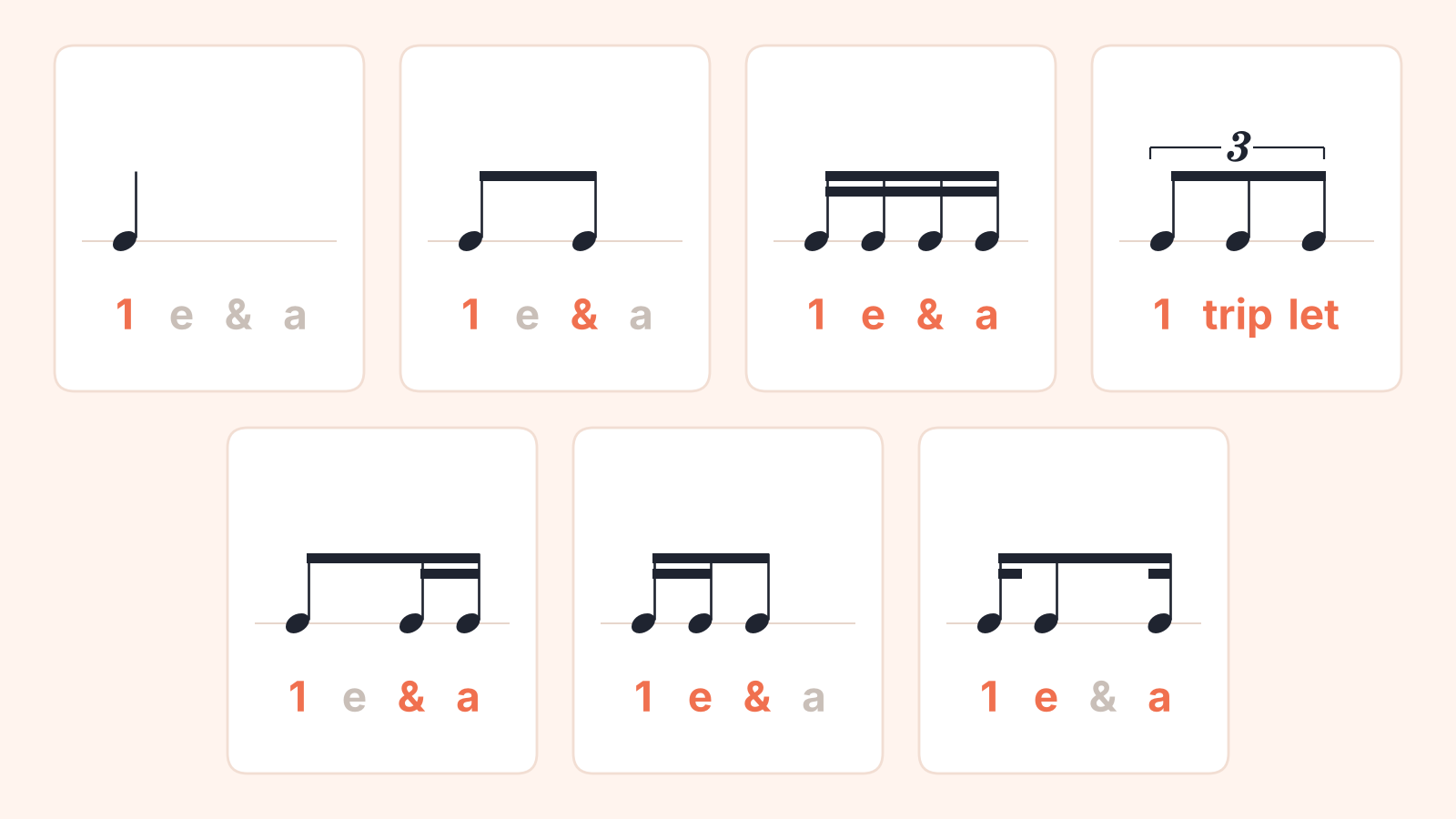
| Rhythm (one beat unless noted) | Count | Notes sound on |
|---|---|---|
| Whole note (4 beats) | 1 2 3 4 | 1 |
| Half note (2 beats) | 1 2 | 1 |
| Quarter note | 1 | 1 |
| Two eighth notes | 1 & | 1, & |
| Four sixteenth notes | 1 e & a | 1, e, &, a |
| Eighth + two sixteenths | 1 e & a | 1, &, a |
| Two sixteenths + eighth | 1 e & a | 1, e, & |
| Sixteenth + eighth + sixteenth | 1 e & a | 1, e, a |
| Eighth-note triplet | 1 trip let | 1, trip, let |
For mixed patterns, keep saying all four syllables and clap only where a note starts. In "eighth + two sixteenths", you still think the "e", but the eighth note is held through it.
How do you count rests and dotted notes?
You count rests exactly like notes, but stay silent on them. A quarter rest still gets its number, so in "1 2 (3) 4" you think "3" without playing.
A dotted note lasts one and a half times its normal value. A dotted quarter note lasts 1½ beats, so a dotted quarter followed by an eighth is counted "1 (2) &": the note starts on 1, is held through 2, and the eighth note falls on the "&" of 2.
What other counting systems are there?
Numbers with "e & a" are a common system, but some teachers use rhythm syllables instead.
| System | Quarter note | Two eighths | Four sixteenths | Often used for |
|---|---|---|---|---|
| Numbers | 1 | 1 & | 1 e & a | Reading music, band and orchestra |
| Kodály syllables | ta | ti-ti | ti-ri-ti-ri or ti-ka-ti-ka | Young children, classroom music |
| Takadimi | ta | ta-di | ta-ka-di-mi | Aural skills and sight-singing |
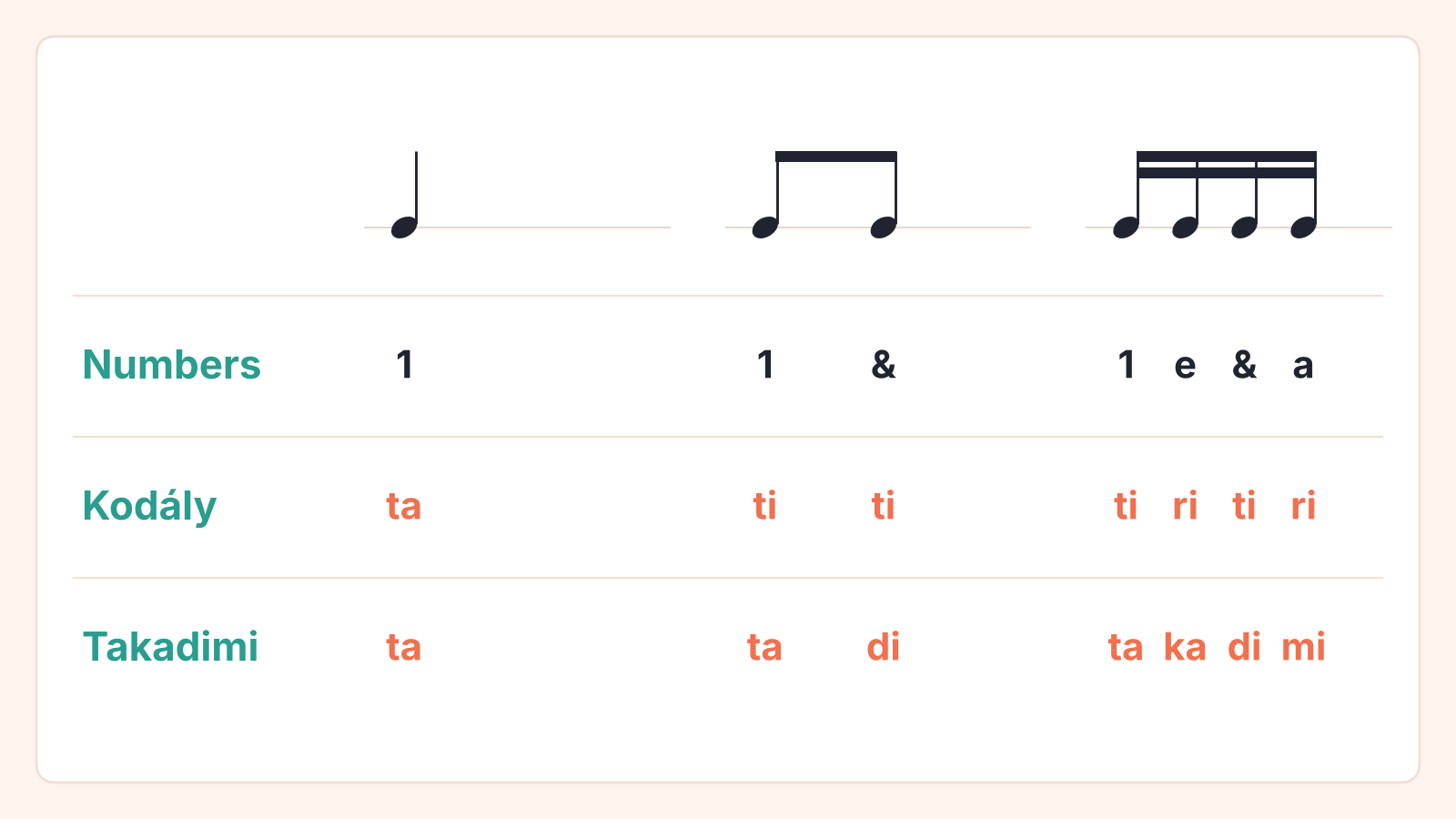
Takadimi was developed by Richard Hoffman, William Pelto and John W. White in the 1990s. The system you pick matters less than using it consistently: the key skill is to keep the pulse steady and the division exact.
5 rhythm exercises to improve your timing
These five exercises take a rhythm from reading to playing.
- Clap and count aloud. Before you play, clap the rhythm while saying "1 e & a" continuously. Clap only where a note starts.
- Hear the tempo first. Listen to 5 to 10 metronome clicks before you start, so the pulse is in your body before your hands move.
- Set the metronome to the subdivision. At slow tempos, click the eighth notes instead of the beat. If a passage is marked quarter note = 50, set the metronome to 100.
- Climb the tempo ladder. Start at a tempo you can play accurately, raise it by 2 clicks at a time, and drop back to the starting tempo whenever accuracy slips.
- Put the click on the offbeats. Once the rhythm feels secure, a common advanced exercise is to hear the metronome as the "&"s and play the beats in between. This tests whether you can keep the pulse yourself.
Many musicians find it hard to count aloud and play at the same time, so keep counting in your head while you play.
How can you check if your rhythm is accurate?
The easiest way to check your rhythm is to record yourself and listen back, because rushing and dragging are hard to hear while you play.
MusPal is an AI music practice app: scan your sheet music with your phone, play or sing, and the AI points out rhythm and pitch problems bar by bar. You can see exactly which beat came early or late, then go back to the counting exercises above. Learn more about AI practice. For setting up practice tempos, see how to use a metronome.
FAQ
How do you count sixteenth notes? Count four sixteenth notes as "1 e & a". The number falls on the beat, "&" falls halfway through, and "e" and "a" fall in between.
How do you count triplets? Count an eighth-note triplet as "1 trip let": three equal notes in the space of one beat.
Should I count out loud? Counting aloud helps when you first learn a rhythm. Once you can clap it accurately, keep counting in your head while you play.
How can I improve my rhythm quickly? Practise slowly with a metronome, raise the tempo only when the rhythm is accurate, and record yourself to check. Short daily practice generally works better than one long session.
Sources
- LibreTexts (Sierra College): Counting Methods and Sixteenth Notes
- Charles Leinberger, University of Texas at El Paso: The "1 E & A" Counting System
- Wikipedia: Counting (music) and Takadimi
- Eastman Community Music School: metronome practice tips
- Keri McCarthy, Washington State University: Slow Practice
Update log
- 2026-11-27: First published.
Free plan: scans and AI analyses every month