
For beginners, parents and self-learners: how long every note and rest lasts, plus dotted notes, fermatas and how to draw notes correctly.
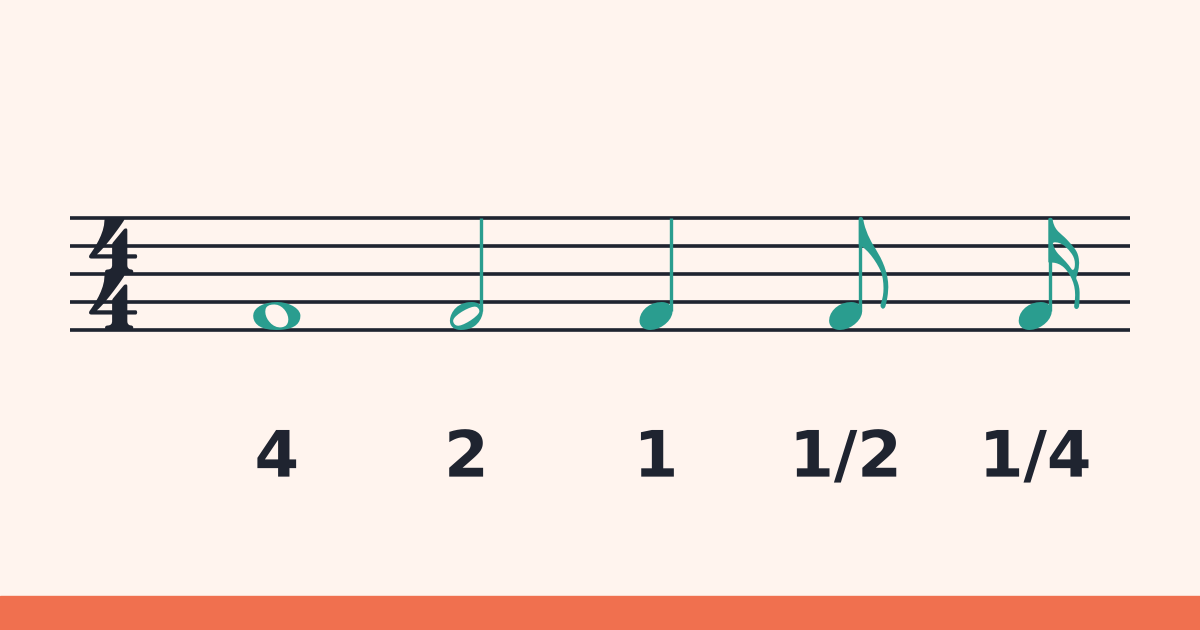
When the quarter note gets one beat, a whole note lasts 4 beats, a half note 2, a quarter note 1, an eighth note 1/2 and a sixteenth note 1/4. Each extra flag halves the value, and a dot adds half of the note's value.
What are note values?
A note value is how long a note lasts, measured in beats. The shape of the note tells you its value: an open or filled notehead, a stem or no stem, and the number of flags.
Note values are relative: each note is half as long as the one before it. How long one beat lasts in seconds depends on the tempo, which you set with a metronome (see How to Use a Metronome).
This guide counts the quarter note as one beat, as in 2/4, 3/4 and 4/4 time. In 6/8 time, the beat is a dotted quarter note: each bar has 2 beats, and each beat splits into 3 eighth notes.
Note values chart: how many beats does each note get?
A whole note gets 4 beats, a half note 2, a quarter note 1, an eighth note 1/2 and a sixteenth note 1/4. British names (used by ABRSM and Trinity) are in brackets:
| Note | British name | What it looks like | Beats |
|---|---|---|---|
| Whole note | semibreve | open notehead, no stem | 4 |
| Half note | minim | open notehead + stem | 2 |
| Quarter note | crotchet | filled notehead + stem | 1 |
| Eighth note | quaver | filled notehead + stem + 1 flag | 1/2 |
| Sixteenth note | semiquaver | filled notehead + stem + 2 flags | 1/4 |
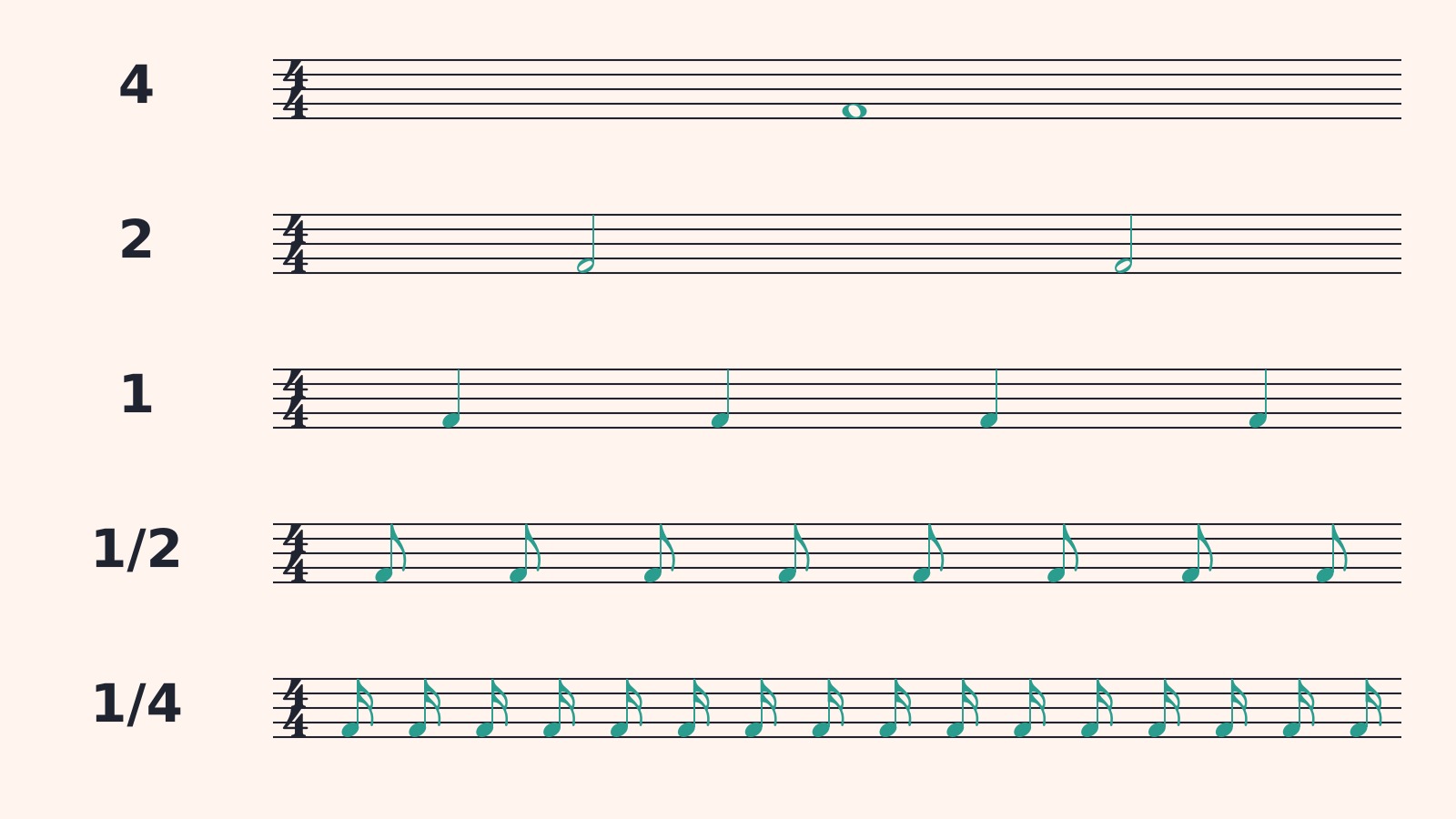
How they add up: 1 whole note = 2 half notes = 4 quarter notes = 8 eighth notes = 16 sixteenth notes.
Every extra flag halves the value. A thirty-second note (demisemiquaver) has 3 flags and lasts 1/8 of a beat; it is generally rare in beginner pieces.
How many beats is each rest?
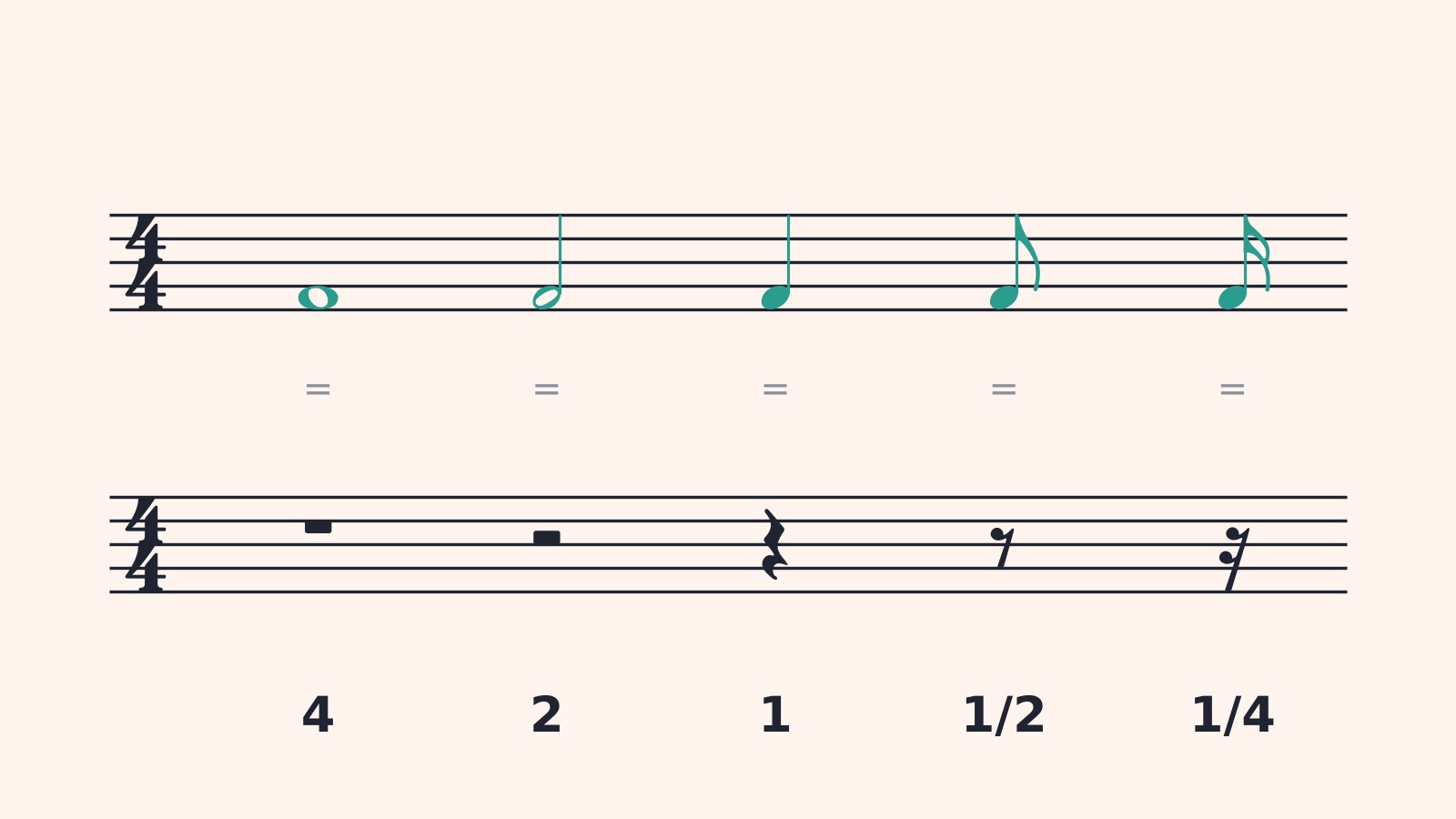
Every note has a rest of the same length: a whole rest lasts 4 beats, a half rest 2, a quarter rest 1, an eighth rest 1/2 and a sixteenth rest 1/4.
| Rest | What it looks like | Beats |
|---|---|---|
| Whole rest | a small block that hangs below the fourth line | 4 |
| Half rest | a small block that sits on the third line | 2 |
| Quarter rest | a zigzag shape in the middle of the staff | 1 |
| Eighth rest | looks like a "7" | 1/2 |
| Sixteenth rest | like a "7" with two hooks | 1/4 |
The whole and half rest are easy to mix up: the "heavy" whole rest hangs, the "light" half rest sits.
A whole bar of silence always uses a whole rest, in 2/4, 3/4 or 4/4.
How long is a dotted note?
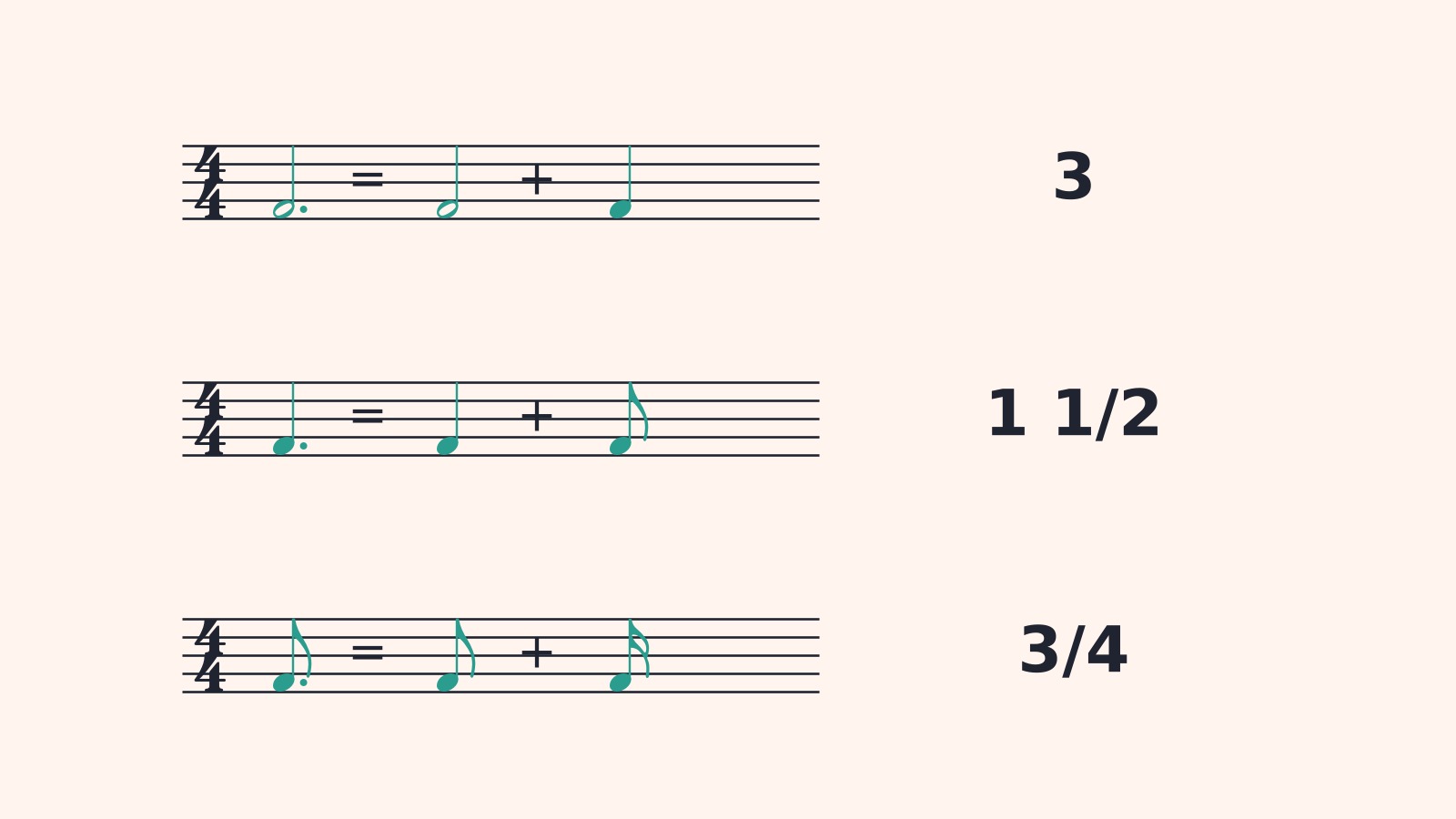
A dot adds half of the note's value: a dotted half note lasts 3 beats, a dotted quarter note 1 1/2 beats and a dotted eighth note 3/4 of a beat.
| Dotted note | Sum | Beats |
|---|---|---|
| Dotted whole note | 4 + 2 | 6 |
| Dotted half note | 2 + 1 | 3 |
| Dotted quarter note | 1 + 1/2 | 1 1/2 |
| Dotted eighth note | 1/2 + 1/4 | 3/4 |
Rests can be dotted too, with the same maths. A dotted quarter rest lasts 1 1/2 beats.
Some beginners think the dot doubles the note. It only adds half: a dotted half note is 3 beats, not 4.
How many beats is a fermata?
A fermata (𝄐) has no fixed number of beats. It tells you to hold the note longer than written; the performer or conductor decides how long, and about twice the written value is common.
- Quarter note with a fermata: in practice, start by counting about 2 beats
- Whole note with a fermata: start with about 8 beats, then shape it to the music
- In a band, orchestra or choir, release the note when the conductor does
For what a fermata means and its other uses, see the Music Glossary.
How do you draw notes, and which way do stems go?
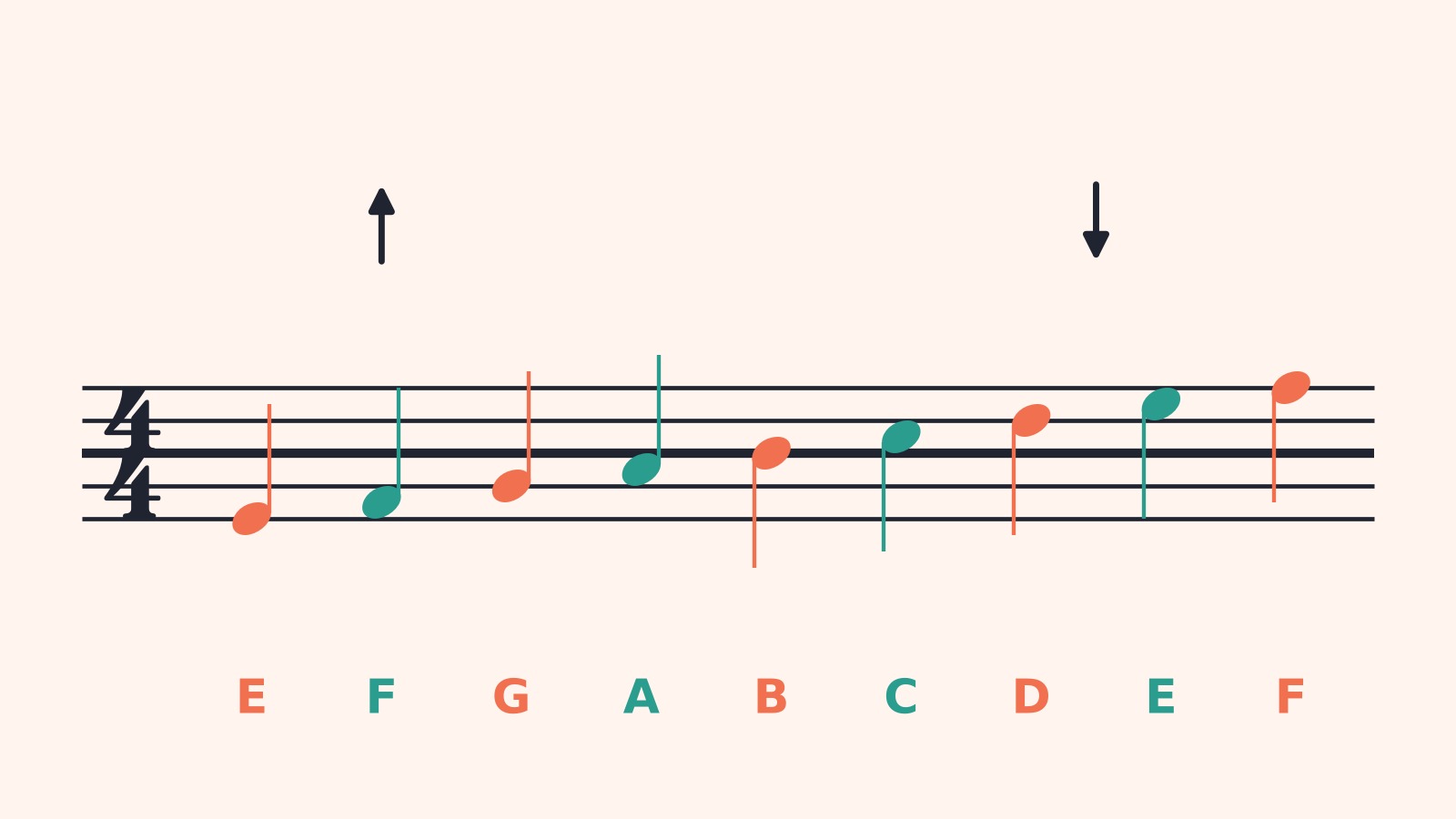
A note has a notehead, a stem and sometimes flags. Notes below the middle line have stems pointing up on the right of the notehead; notes above it have stems pointing down on the left; a note on the middle line can go either way, depending on the notes around it.
- Notehead: an oval tilted slightly up to the right; a line note has the line through its middle, a space note just touches the lines above and below
- Stem: a straight line; when hand-drawn, about as long as four staff lines are tall
- Flags: always on the right of the stem, whether the stem goes up or down; eighth notes have 1 flag, sixteenths have 2
- Beams: two or more eighth or sixteenth notes can be joined with a thick line, which makes the beats easier to read
Not sure which line or space a note sits on? See Notes on the Staff.
How do you practise counting beats?
A common method is to clap and count out loud, then add a metronome to keep the beat steady.
- Start with quarter notes: in 4/4, count "1, 2, 3, 4" and clap on every beat
- Add half and whole notes: clap once, then keep counting without clapping
- Add eighth notes: count "1 and 2 and 3 and 4 and", clapping on every word
- Finally add dots and rests: count rests out loud but do not clap
When you play, you can scan the page with MusPal and play it to the app. The AI compares your rhythm note by note and shows which notes were too short or too long, so you can see exactly which beat went wrong. The free plan includes 3 scans a month.
New to reading music? Start with How to Read Sheet Music.
FAQ
How many beats is a whole note? When the quarter note gets one beat, a whole note lasts 4 beats, the same as 4 quarter notes.
How many beats is a dotted quarter note? One and a half: the quarter note is 1 beat and the dot adds half a beat.
How many beats is a fermata? A fermata has no fixed length; the performer or conductor decides, and about twice the written value is common.
Do note stems go up or down? Below the middle line, stems go up on the right; above it, they go down on the left; on the middle line, either direction is correct.
Do rests have the same values as notes? Yes. Every note has a rest of the same length, so a quarter rest is 1 beat and a whole rest is 4 beats.
Sources
- Note Duration – 8notes (musictheory.net lesson)
- Time Names of Notes – My Music Theory
- The Different Types Of Rests In Music – Hello Music Theory
- Fermata – Wikipedia
- Time signature – Wikipedia
- 1.2: Notation of Notes, Clefs, and Ledger Lines – LibreTexts, Open Music Theory
Free plan: 3 scans + 3 AI analyses every month