
For students, parents and self-learners who sing or play off-pitch: find out why it happens, then fix it with 6 exercises.
Singing in tune means hitting the exact pitch written in the music. In one study, 10–15% of participants sang at least a semitone off, yet true tone deafness (congenital amusia) affects only about 1.5% of people, so many pitch problems may improve with practice.
What does singing in tune mean?
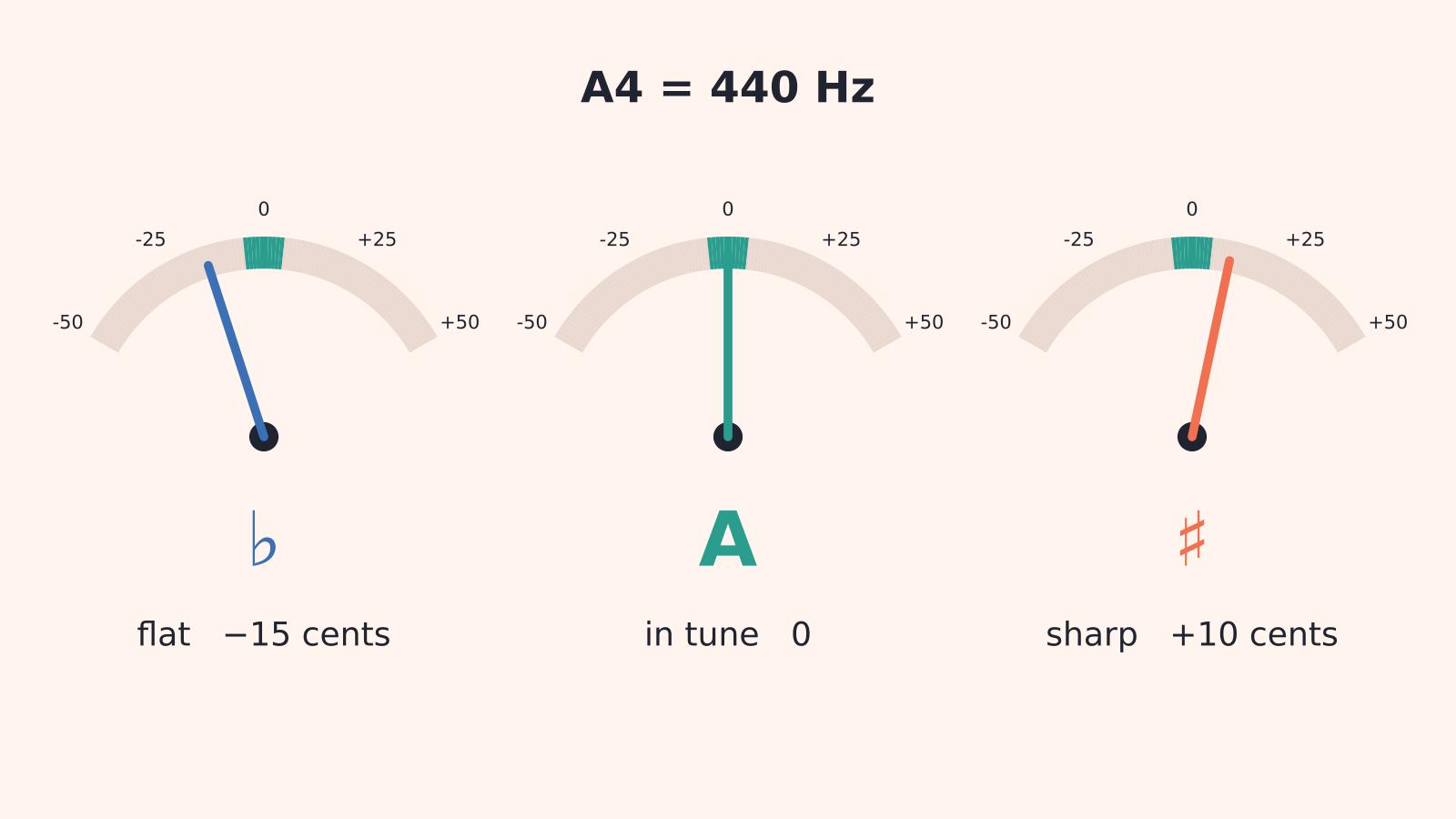
Singing in tune means your note matches the target pitch. A note that is too high is sharp; a note that is too low is flat.
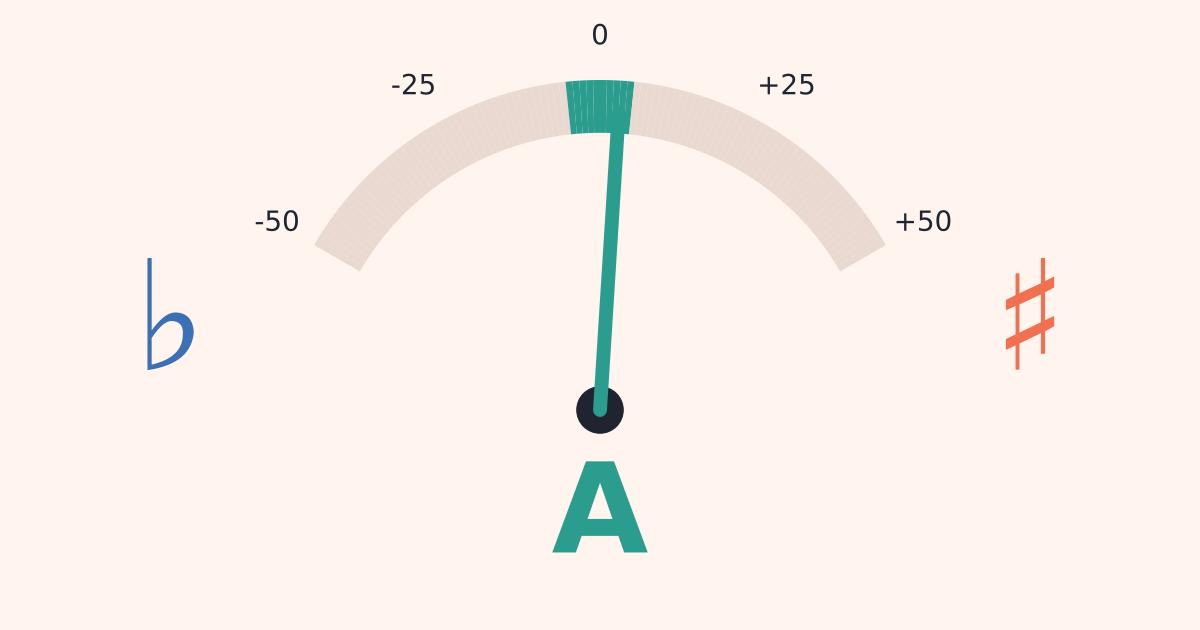
One semitone equals 100 cents, the distance between two neighbouring piano keys. When a tuner shows “+10” or “−15”, the note is 10 cents sharp or 15 cents flat.
Why do I sing off-key? 3 common causes
Singing off-key is not always a hearing problem. The cause can sit in listening, in producing the sound, or in the instrument:
| Cause | What it looks like | What to practise |
|---|---|---|
| Can't hear pitch differences (congenital amusia) | Can't tell which of two notes is higher | Only about 1.5% of people; ask a professional if needed |
| Hears pitch but can't reproduce it | Whole melody sits too high or too low; intervals get squeezed | Link hearing to singing (exercises 1–3) |
| Instrument or finger placement | Strings out of tune, fingers slightly off | Tune first, then practise slowly (exercises 4–6) |
A 2007 study found that poor-pitch singers were just as good at telling pitches apart as accurate singers. The researchers suggest the problem more likely lies in linking what you hear to what you sing. Violins and cellos have no frets, so pitch depends entirely on finger placement, which makes them easier to play out of tune.
How can I learn to sing in tune?
- Match one long note: play a note on a piano or tuner app and sing it for 4–5 seconds, noticing whether you drift sharp or flat.
- Record yourself and listen back: it is hard to judge your pitch while singing; on playback, mistakes are usually easier to hear.
- Sing scales slowly, one note at a time: play each note on a piano, then sing Do-Re-Mi-Fa-Sol slowly, moving on only when the note is in tune.
How do I improve violin intonation?
- Tune your strings every time: practising on out-of-tune strings trains your left hand to find the wrong spots.
- Play scales slowly and check against open strings: play scales slowly with a metronome, since slow practice reveals pitch errors you miss at tempo. On notes that match an open string (G, D, A, E – called “ringing tones” in the Suzuki method), an in-tune note makes the open string vibrate and the violin ring; slightly sharp or flat, that resonance disappears and the sound turns drier. This clear resonance mainly applies to these four notes; check the others with slow practice and recordings. Another common approach is to have someone hold the tonic on a piano while you play the scale against it.
- Leave out vibrato at first: vibrato can hide the exact pitch, so get each note in tune slowly first, then speed up.
The same approach works for viola, cello and other string instruments. Keep the tempo slow while you work on pitch; for counting, see How to Count Rhythms.
How do I know which notes are off?
A tuner checks one note at a time, which is hard to follow through a whole piece. With MusPal you can scan the sheet music, then upload a recording of your singing or playing. The AI compares pitch and rhythm note by note and shows which notes were sharp or flat. This works for scales too: scan the scale's sheet music and record it. MusPal works with instruments and with voice.
FAQ
Can you learn to sing in tune?
In many cases, yes. Only about 1.5% of people truly can't hear pitch differences; other pitch problems may come from hearing and singing not yet working together, which practice such as note matching and recording can improve.
Is being tone deaf genetic?
Congenital amusia may run in families, but research estimates it affects only about 1.5% of people.
Should I use finger tapes on the violin?
Some teachers use them for beginners, while others feel relying on tapes for too long means listening less. Ask your teacher.
Does practising with a tuner help intonation?
A tuner helps you check single notes, but it also helps to train your ear, for example by comparing notes with your open strings.
Free plan: scans and AI analyses every month