
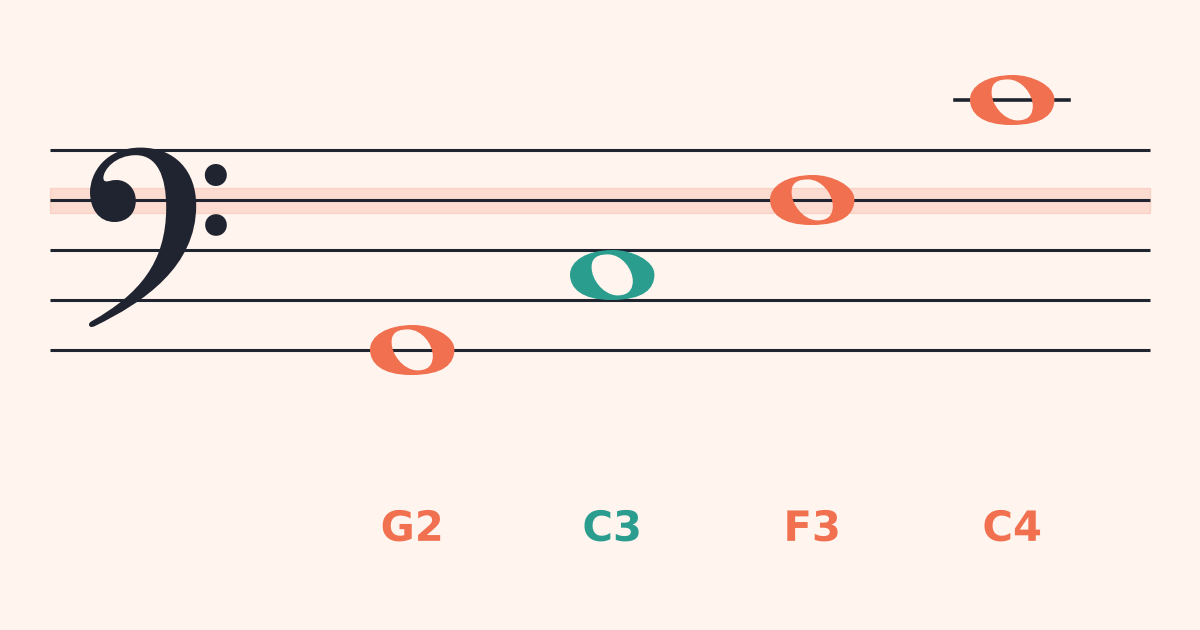
For piano beginners, parents and self-learners: what the bass clef (F clef) means, how to read left-hand notes from 3 landmark notes, and where middle C and the ledger-line notes sit.
The bass clef, or F clef, marks the fourth line as the F below middle C. Its lines from bottom to top are G, B, D, F, A, its spaces are A, C, E, G, and middle C sits on the first ledger line above.
What is the bass clef and why is it called the F clef?
The bass clef is the clef used for low notes. Its two dots sit either side of the fourth line, which marks that line as F, so the bass clef is also called the F clef. This F is the first F below middle C (F3).
The symbol grew out of a written letter F. Early scribes are generally thought to have written a letter at the start of a line to show which pitch it stood for, and the letter gradually became today's curved shape.
The bass clef keeps most low notes inside the five lines, so they need few ledger lines. The same symbol placed on the third line is the baritone clef, which you are unlikely to see today.
What are the notes on the bass clef lines and spaces?
The five bass clef lines from bottom to top are G, B, D, F, A. The four spaces from bottom to top are A, C, E, G.
| Position (bottom to top) | Note | Pitch |
|---|---|---|
| Line 1 | G | G2 |
| Space 1 | A | A2 |
| Line 2 | B | B2 |
| Space 2 | C | C3 |
| Line 3 | D | D3 |
| Space 3 | E | E3 |
| Line 4 | F | F3 |
| Space 4 | G | G3 |
| Line 5 | A | A3 |
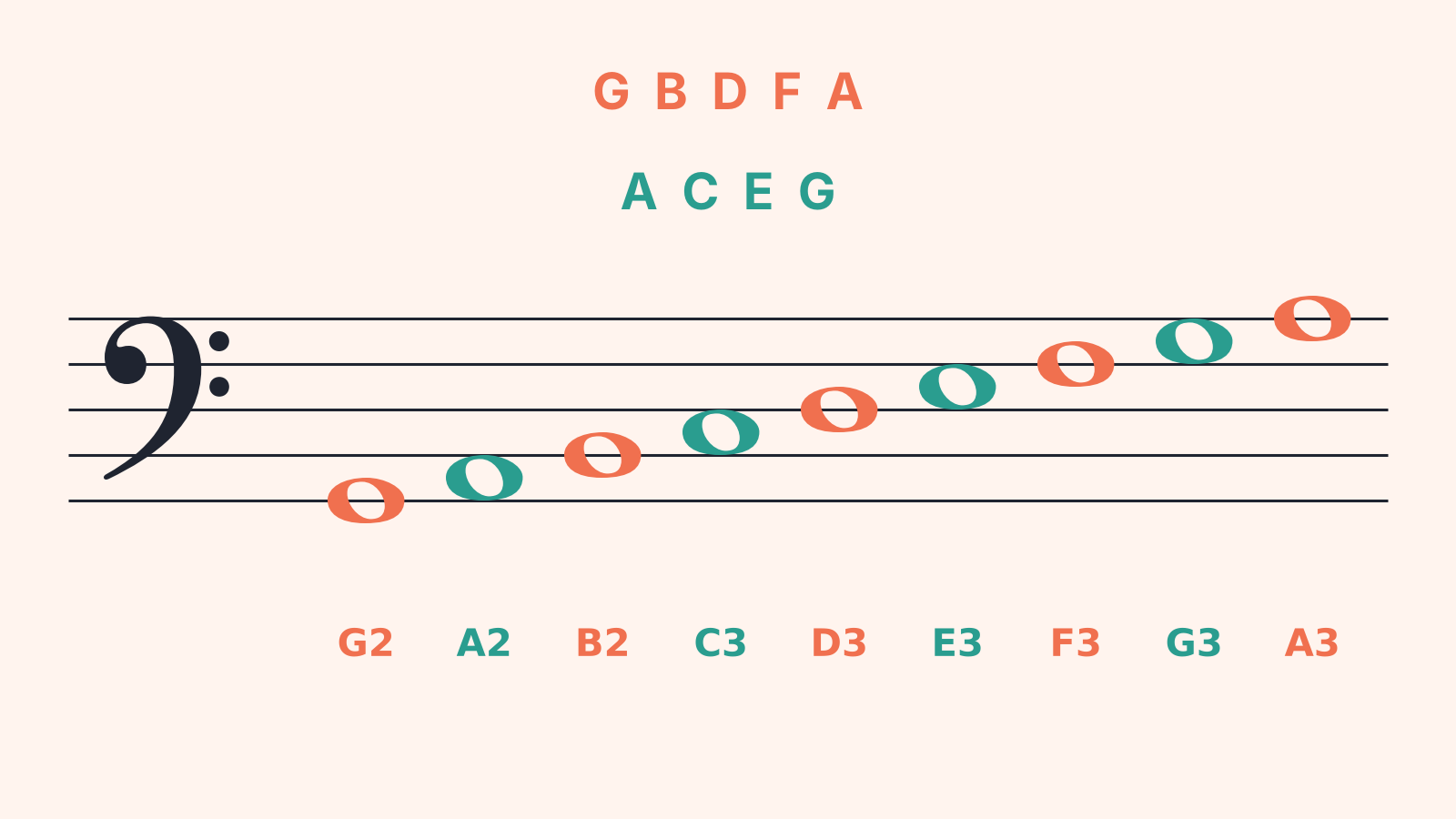
The number shows the octave: middle C is C4, so C3 is the C one octave below middle C.
For the memory sentences (Good Boys Do Fine Always, All Cows Eat Grass), see Notes on the Staff.
How do you read bass clef notes quickly?
The fastest way is to learn 3 landmark notes first: F on the fourth line, C in the second space and middle C on the first ledger line above. Find every other note by counting up or down from the nearest landmark.
| Landmark | Position | How to spot it |
|---|---|---|
| F (F3) | Line 4 | The line between the clef's two dots |
| C (C3) | Space 2 | One octave below middle C; some beginner books put the left-hand little finger here for the C position (methods vary) |
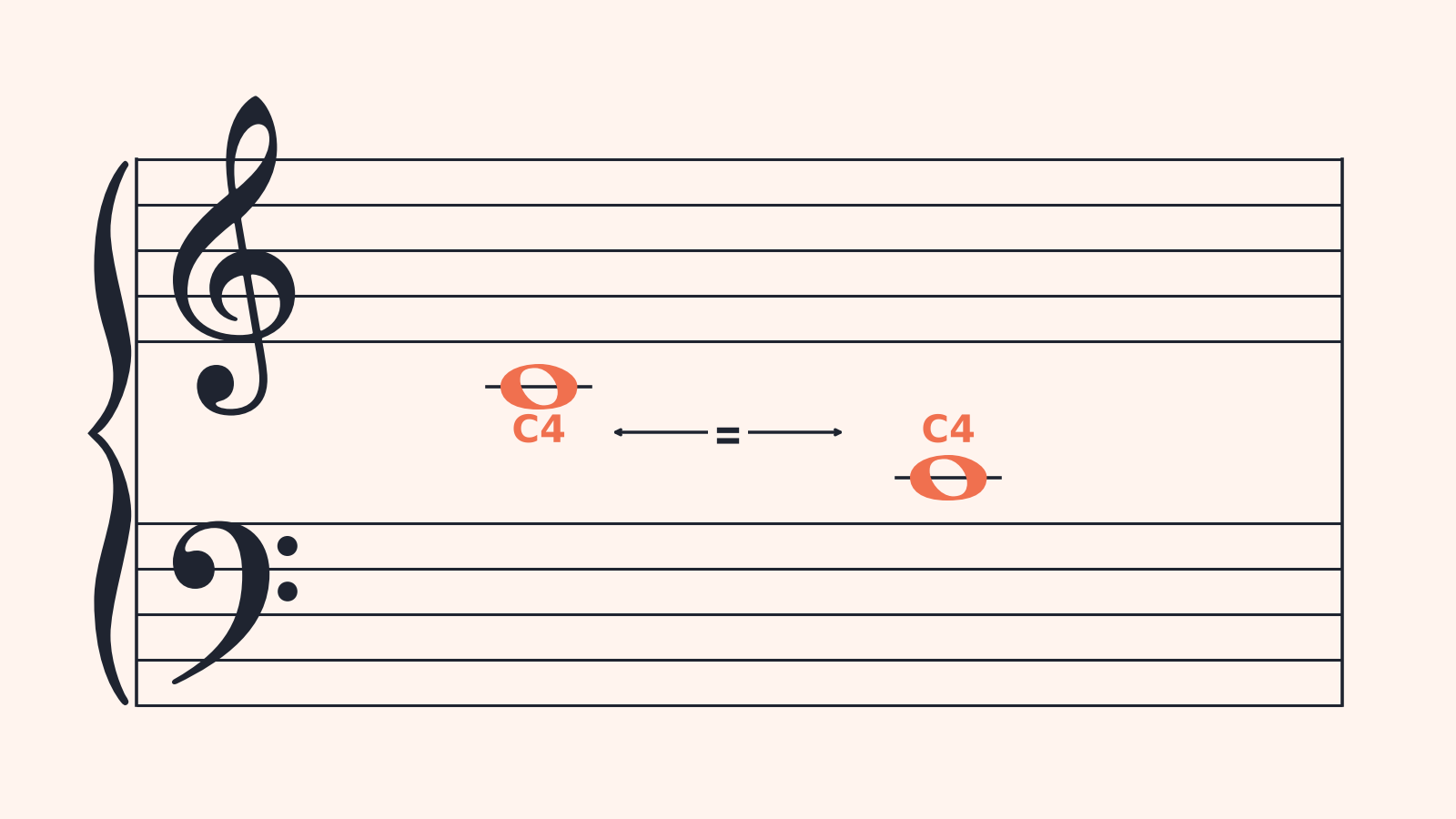
| Middle C (C4) | 1st ledger line above | The same note as the 1st ledger line below the treble staff |
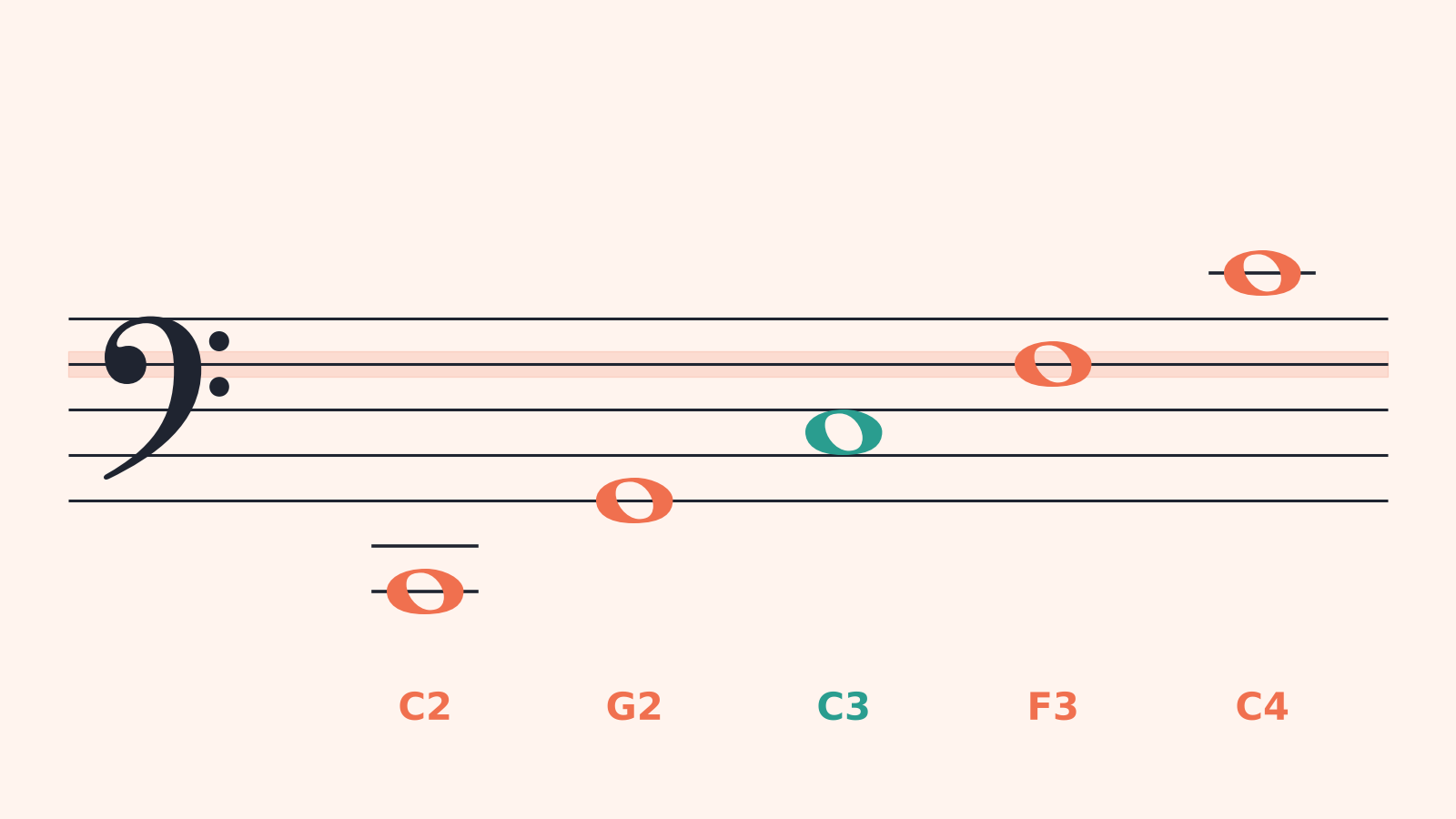
Add G on the bottom line (G2) and C on the second ledger line below (C2), and most notes in easy left-hand music should have a landmark nearby.
- Line to the next space: the next letter. The space above F is G
- Line to line, or space to space: skip one letter. The line above F is A, and the space above C is E
Where are middle C and the ledger-line notes in bass clef?
Middle C sits on the first ledger line above the bass staff. Above it come D and E; below the staff, the first ledger line is E and the second is C.
| Position | Note |
|---|---|
| 2nd ledger line above | E (E4) |
| Above the 1st ledger line | D (D4) |
| 1st ledger line above | C (C4, middle C) |
| Space above line 5 | B (B3) |
| Space below line 1 | F (F2) |
| 1st ledger line below | E (E2) |
| Below the 1st ledger line | D (D2) |
| 2nd ledger line below | C (C2) |
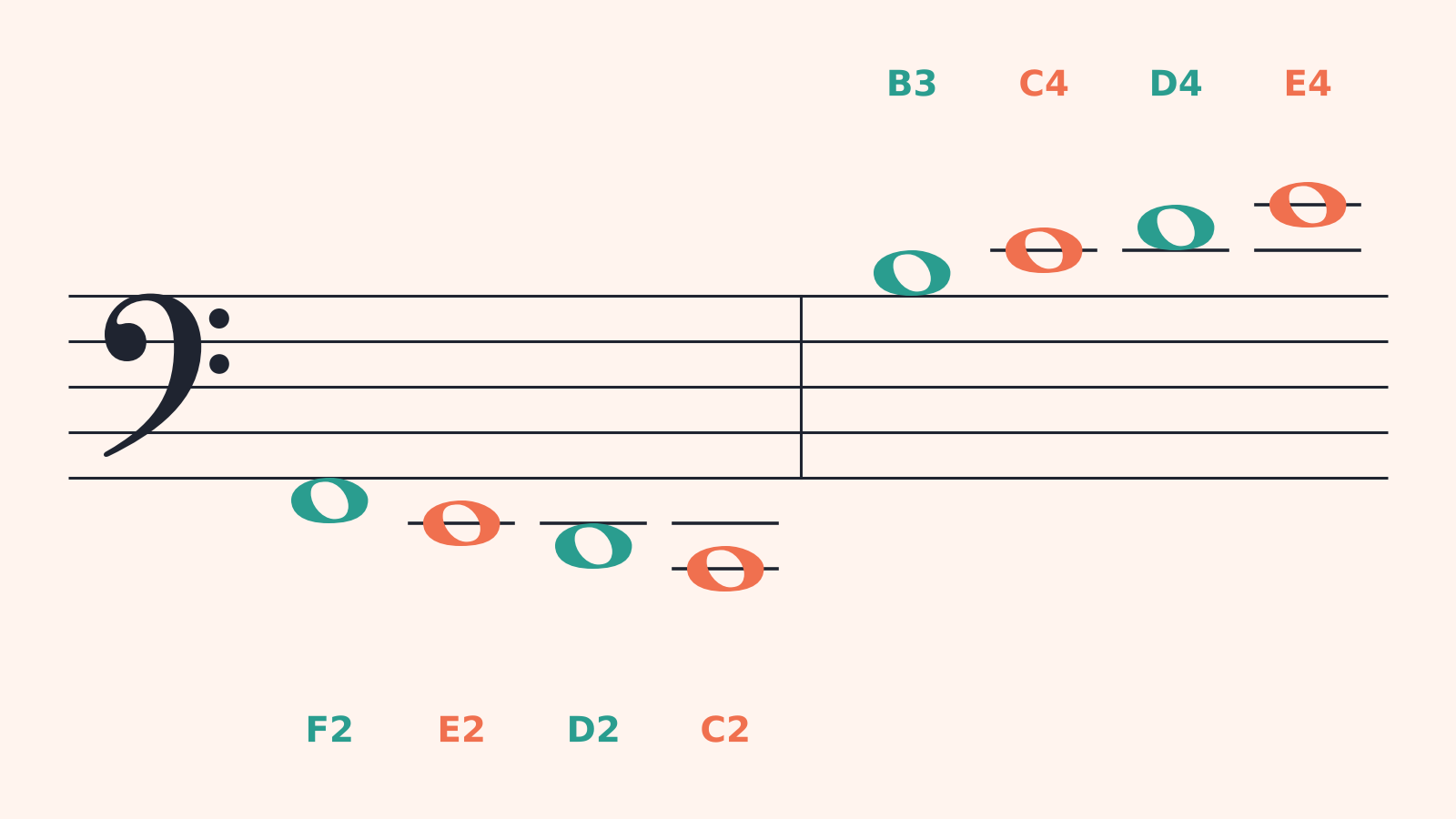
To read a ledger note, first count the ledger lines, then check whether the line runs through the note (on a line) or the note hangs next to it (in a space).
Piano music uses the grand staff: treble clef on top, bass clef below, joined by a brace. Middle C written below the treble staff or above the bass staff is the same key in the middle of the piano.
What is the difference between bass clef and treble clef?
The treble clef marks the second line as G; the bass clef marks the fourth line as F. On the same line or space, the bass clef note is two letters later than the treble clef note, and much lower.
| Treble clef | Bass clef | |
|---|---|---|
| Other name | G clef | F clef |
| Reference line | Line 2 = G (G4) | Line 4 = F (F3) |
| Bottom line | E (E4) | G (G2) |
| Top line | F (F5) | A (A3) |
| Middle C | 1st ledger line below | 1st ledger line above |
| Piano | Usually right hand | Usually left hand |
A mistake beginners often make is reading bass clef with treble clef positions, for example calling the bottom line E when it is G.
Which instruments use the bass clef?
The piano left hand, cello, double bass, bassoon, trombone, tuba and timpani all read mainly in bass clef.
- Cello, bassoon, trombone: switch to the tenor clef or other clefs for high passages
- Double bass: sounds one octave lower than written, which is usually explained as a way to keep very low notes from needing many ledger lines
- Piano left hand: not always in bass clef; when the left hand plays high, the staff may switch to treble clef, so watch for clef changes
How can you get fluent at reading bass clef?
Practise a little every day: learn the landmarks, count from them, then play the notes on the piano.
- Learn only the 3 landmarks: F, C and middle C, until you can name them at a glance
- Count from the landmarks: one step (line to space), then two steps (line to line)
- Read at random: use flashcards or practice sheets in mixed order
- Read and play: name the note, then find it on the piano with your left hand
Once you can read the notes, scan your left-hand piece with MusPal and play it to the app. The AI checks each note's pitch and shows which bar had a wrong note, so you can see which position you misread. The free plan scans 3 pieces of sheet music per month.
New to notation? Start with How to Read Sheet Music, and for rhythm see the Note Values Chart.
FAQ
What note is on the bottom line of the bass clef? G (G2). The lines from bottom to top are G, B, D, F, A.
Why is the bass clef called the F clef? Its two dots sit either side of the fourth line, marking that line as F, the F below middle C.
Where is middle C in bass clef? On the first ledger line above the staff. It is the same note as the first ledger line below the treble staff.
How do you draw a bass clef? A common way: start with a solid dot on the fourth line, curve up over the top line and down, then add one dot in the space above and one in the space below the fourth line.
Does the piano left hand always read bass clef? No. When the left hand plays high notes, the music may switch to treble clef, so check the clef at the start of each line and mid-line.
Sources
- The Bass Clef – My Music Theory
- Bass Clef – Hello Music Theory
- Bass Clef – Key Notes
- F-clef or bass clef or baritone clef – Music4VIP
- Instruments, Transposition and Clefs – My Music Theory
- Range, Transposition, and Clefs – Radius Music
Free plan: 3 scans + 3 AI analyses every month